Category:Business: Difference between revisions
No edit summary |
|||
| Line 7: | Line 7: | ||
A map with a conceptual overview of the peer to peer business space. ''Every concept in the map is searchable via our wiki search box on the left''. | A map with a conceptual overview of the peer to peer business space. ''Every concept in the map is searchable via our wiki search box on the left''. | ||
Recommended reading: | Recommended reading: | ||
| Line 30: | Line 29: | ||
*The peer producers are their own consumers. They get a better product by tapping into the knowledge pool. And they get a product that exactly fits their needs because they help design it. - Eric Schonfeld [http://www.business2.com/b2/web/articles/0,17863,1112586,00.html] | *The peer producers are their own consumers. They get a better product by tapping into the knowledge pool. And they get a product that exactly fits their needs because they help design it. - Eric Schonfeld [http://www.business2.com/b2/web/articles/0,17863,1112586,00.html] | ||
*In this new world, if it doesn’t spread, it’s dead. And those companies which seek to prohibit the manipulation and circulation of their content will find themselves cut off from the mechanisms which generate value in this new media economy. - Henry Jenkins [http://newteevee.com/2007/12/28/ntv-predictions-video-copyright/] | *In this new world, if it doesn’t spread, it’s dead. And those companies which seek to prohibit the manipulation and circulation of their content will find themselves cut off from the mechanisms which generate value in this new media economy. - Henry Jenkins [http://newteevee.com/2007/12/28/ntv-predictions-video-copyright/] | ||
=Long Citations= | =Long Citations= | ||
===Competing 'on top' of the Commons=== | ===Competing 'on top' of the Commons=== | ||
"One of the best ways to stimulate competition, innovation and lower prices is for participants in a market to honor the commons (a shared pool of resources, a minimal set of safety or performance standards) and then to compete "on top" of the commons. Instead of being able to reap easy profits from monopoly control over something everyone needs -- say, a computer operating system like Windows -- a company must work harder to "add value" in more specialized ways." | "One of the best ways to stimulate competition, innovation and lower prices is for participants in a market to honor the commons (a shared pool of resources, a minimal set of safety or performance standards) and then to compete "on top" of the commons. Instead of being able to reap easy profits from monopoly control over something everyone needs -- say, a computer operating system like Windows -- a company must work harder to "add value" in more specialized ways." | ||
(http://onthecommons.org/node/1196) | (http://onthecommons.org/node/1196) | ||
- David Bollier | |||
===The Sharing Economy should be distinguished from the Monetary Economy=== | ===The Sharing Economy should be distinguished from the Monetary Economy=== | ||
"... the quest for self-determination and meaningful and memorable | "... the quest for self-determination and meaningful and memorable | ||
experiences ultimately will hinge on people's understanding that they are | experiences ultimately will hinge on people's understanding that they are | ||
| Line 51: | Line 47: | ||
- Eric Kluitenberg, iDC archive [http://mailman.thing.net/pipermail/idc/] | - Eric Kluitenberg, iDC archive [http://mailman.thing.net/pipermail/idc/] | ||
===Market Logic vs. Network Logic=== | ===Market Logic vs. Network Logic=== | ||
"The philosophy that undergirds exchange also contrasts sharply across forms. '''In markets the standard strategy is to drive the hardest possible bargain in the immediate exchange. In networks, the preferred option is often one of creating indebtedness and reliance over the long haul. Each approach thus devalues the other: prosperous market traders would be viewed as petty and untrustworthy shysters in networks, while successful participants in networks who carried those practices into competitive markets would be viewed as foolish and naive...''' In a market context, it is clear to everyone concerned when a debt has been discharged, but such matters and not nearly as obvious in networks." | "The philosophy that undergirds exchange also contrasts sharply across forms. '''In markets the standard strategy is to drive the hardest possible bargain in the immediate exchange. In networks, the preferred option is often one of creating indebtedness and reliance over the long haul. Each approach thus devalues the other: prosperous market traders would be viewed as petty and untrustworthy shysters in networks, while successful participants in networks who carried those practices into competitive markets would be viewed as foolish and naive...''' In a market context, it is clear to everyone concerned when a debt has been discharged, but such matters and not nearly as obvious in networks." | ||
- Walter Powell - "Niether Market Nor Hierarchy: Network Forms of | - Walter Powell - "Niether Market Nor Hierarchy: Network Forms of | ||
Organization" 1990 | Organization" 1990 | ||
===Markets without Money=== | ===Markets without Money=== | ||
"Money is a very important and useful medium of exchange for high-value, tangible products. For small-value, intangible products, the costs tend to exceed the value of the transactions—especially when you add in the overhead associated with making payments at a distance. Fortunately, human beings are clever. We’ve begun to find a variety of substitutes for money that work better." | "Money is a very important and useful medium of exchange for high-value, tangible products. For small-value, intangible products, the costs tend to exceed the value of the transactions—especially when you add in the overhead associated with making payments at a distance. Fortunately, human beings are clever. We’ve begun to find a variety of substitutes for money that work better." | ||
- Tim Lee [http://www.techliberation.com/archives/040398.php] | - Tim Lee [http://www.techliberation.com/archives/040398.php] | ||
===Social Commerce and the Intention Economy=== | ===Social Commerce and the Intention Economy=== | ||
"only 13% of consumers say they buy products because of their ads. Contrast that to 60% of small business owners in North America that say they use peer recommendations to make their buying decisions and over 70% of 18-35 year olds who report the same for their media purchases." | "only 13% of consumers say they buy products because of their ads. Contrast that to 60% of small business owners in North America that say they use peer recommendations to make their buying decisions and over 70% of 18-35 year olds who report the same for their media purchases." | ||
- Tara Hunt [http://www.horsepigcow.com/2007/09/13/how-to-make-a-gabillion-dollars-with-community-marketingor-something-to-that-effect/] | - Tara Hunt [http://www.horsepigcow.com/2007/09/13/how-to-make-a-gabillion-dollars-with-community-marketingor-something-to-that-effect/] | ||
=Key External Articles= | =Key External Articles= | ||
#On the Economics of the Commons | |||
##[[Circulation of the Common]]. Nick Dyer-Whiteford. | |||
#[[Circulation of the Common]]. Nick Dyer-Whiteford. | ##[[Common Rights vs Collective Rights]] is an essay by Dan Sullivan in which he also explains the difference between [[Common Property]] and collective property. | ||
#[[Common Rights vs Collective Rights]] is an essay by Dan Sullivan in which he also explains the difference between [[Common Property]] and collective property. | ##[[Can peer production make washing machines?]]. By Graham Seaman. | ||
#[[Can peer production make washing machines?]]. By Graham Seaman. | #On [[Information Economics]] | ||
##JP Barlow, “The [[Economy of Ideas]]: [http://www.wired.com/wired/archive/2.03/economy.ideas_pr.html A framework for patents and copyrights in the Digital Age]”, Wired 2.03 (March 1994) | |||
##E Dyson , “[http://www.wired.com/wired/archive/3.07/dyson_pr.html Intellectual Value]”, Wired 3.07 (July 1995) | |||
##K Kelly, “The [http://www.wired.com/wired/archive/4.06/romer_pr.html Economics of Ideas]”, Wired 4.06 (June 1996) | |||
#On [[Open Source]] economics | |||
##[http://mitpress.mit.edu/books/chapters/0262562278chap3.pdf The economics of open source] | |||
##[http://mitpress.mit.edu/books/chapters/0262562278chap14.pdf Open source as user innovation] – von Hippel | |||
##[http://mitpress.mit.edu/books/chapters/0262562278chap15.pdf Analysis of OS Business models] | |||
##[http://mitpress.mit.edu/books/chapters/0262562278chap16.pdf Allocation of resources in OS mode] | |||
##[http://mitpress.mit.edu/books/chapters/0262562278chapm2.pdf Open source outside software] – Clay Shirky | |||
#On the Economics of Participation | |||
##[[Ten Principles for an Ethical Blogger Approach For Marketers]] | |||
##[http://blogs.salon.com//2006/12/05.html#a1717 Which tools to use for collaboration in business?] - recommended overview table. | |||
##The [http://wiki.icommons.org/index.php/The_OpenBusiness_Guide Open Business Guide] | |||
=Key Internal Entries= | =Key Internal Entries= | ||
Check the following priority entries: | Check the following priority entries: | ||
#From consumption to produsage | #From consumption to produsage | ||
| Line 153: | Line 134: | ||
##The new capitalism | ##The new capitalism | ||
###[[Hacker Class]], [[Netarchical Capitalism]] ; [[P2P Capitalism]] ; [[Cooperative Capitalism]] ; [[Peer Production Entrepreneurs]] | ###[[Hacker Class]], [[Netarchical Capitalism]] ; [[P2P Capitalism]] ; [[Cooperative Capitalism]] ; [[Peer Production Entrepreneurs]] | ||
=Key Tags= | =Key Tags= | ||
[http://del.icio.us/mbauwens/P2P-Advertising P2P-Advertising]; [http://del.icio.us/mbauwens/Crowdsourcing Crowdsourcing]; [http://del.icio.us/mbauwens/Desktop-Manufacturing Desktop Manufacturing]; [http://del.icio.us/mbauwens/Distributed-Capitalism Distributed Capitalism]; [http://del.icio.us/mbauwens/Innovation Innovation]; [http://del.icio.us/mbauwens/Netarchical-Capitalism Netarchical Capitalism]; [http://del.icio.us/mbauwens/Open-Source-Commercialization Open Source Commercialization]; [http://del.icio.us/mbauwens/P2P-Banking P2P Banking]; [http://del.icio.us/mbauwens/P2P-Business P2P Business Developments]; [http://del.icio.us/mbauwens/P2P-Capitalism P2P Capitalism]; [http://del.icio.us/mbauwens/P2P-Economics P2P Economics]; [http://del.icio.us/mbauwens/P2P-Exchanges P2P Exchanges]; [http://del.icio.us/mbauwens/P2P-Management P2P Management Developments]; [http://del.icio.us/mbauwens/P2P-Money P2P-Money]; [http://del.icio.us/mbauwens/P2P-Production P2P-Production]; [http://del.icio.us/mbauwens/P2P-Property P2P-Property]; [http://del.icio.us/mbauwens/Revenue-Sharing Revenue Sharing]; [http://del.icio.us/mbauwens/Social-Commerce Social Commerce] | [http://del.icio.us/mbauwens/P2P-Advertising P2P-Advertising]; [http://del.icio.us/mbauwens/Crowdsourcing Crowdsourcing]; [http://del.icio.us/mbauwens/Desktop-Manufacturing Desktop Manufacturing]; [http://del.icio.us/mbauwens/Distributed-Capitalism Distributed Capitalism]; [http://del.icio.us/mbauwens/Innovation Innovation]; [http://del.icio.us/mbauwens/Netarchical-Capitalism Netarchical Capitalism]; [http://del.icio.us/mbauwens/Open-Source-Commercialization Open Source Commercialization]; [http://del.icio.us/mbauwens/P2P-Banking P2P Banking]; [http://del.icio.us/mbauwens/P2P-Business P2P Business Developments]; [http://del.icio.us/mbauwens/P2P-Capitalism P2P Capitalism]; [http://del.icio.us/mbauwens/P2P-Economics P2P Economics]; [http://del.icio.us/mbauwens/P2P-Exchanges P2P Exchanges]; [http://del.icio.us/mbauwens/P2P-Management P2P Management Developments]; [http://del.icio.us/mbauwens/P2P-Money P2P-Money]; [http://del.icio.us/mbauwens/P2P-Production P2P-Production]; [http://del.icio.us/mbauwens/P2P-Property P2P-Property]; [http://del.icio.us/mbauwens/Revenue-Sharing Revenue Sharing]; [http://del.icio.us/mbauwens/Social-Commerce Social Commerce] | ||
==Related Issues of P2P News== | ==Related Issues of P2P News== | ||
* [http://integralvisioning.org/article.php?story=p2p103 Funding for peer production], Issue 103 of P2P News | * [http://integralvisioning.org/article.php?story=p2p103 Funding for peer production], Issue 103 of P2P News | ||
* [http://integralvisioning.org/article.php?story=p2p102 P2P and Market Exchange, practices], Issue 102 of P2P News | * [http://integralvisioning.org/article.php?story=p2p102 P2P and Market Exchange, practices], Issue 102 of P2P News | ||
| Line 176: | Line 156: | ||
=External Sources= | =External Sources= | ||
==Selected Wikipedia entries== | ==Selected Wikipedia entries== | ||
* [http://en.wikipedia.org/wiki/Altruistic_Economics Altruistic Economics] | * [http://en.wikipedia.org/wiki/Altruistic_Economics Altruistic Economics] | ||
* [http://en.wikipedia.org/wiki/Genuine_Progress_Indicator Genuine Progress Indicator] | * [http://en.wikipedia.org/wiki/Genuine_Progress_Indicator Genuine Progress Indicator] | ||
| Line 203: | Line 180: | ||
==Selected Podcasts== | ==Selected Podcasts== | ||
*[[Chris Anderson on the Long Tail]] | *[[Chris Anderson on the Long Tail]] | ||
*[[Clayton Christensen on Open Source and Innovation in Business]] | *[[Clayton Christensen on Open Source and Innovation in Business]] | ||
| Line 212: | Line 188: | ||
*[[Michael Goldhaber on the Attention Economy]] | *[[Michael Goldhaber on the Attention Economy]] | ||
*[[Yochai Benkler on the Wealth of Networks]] | *[[Yochai Benkler on the Wealth of Networks]] | ||
=The P2P Business Encyclopedia= | =The P2P Business Encyclopedia= | ||
Revision as of 14:31, 12 January 2008
Introduction
This section collates material related to peer production, P2P Business developments, and P2P Economics issues.

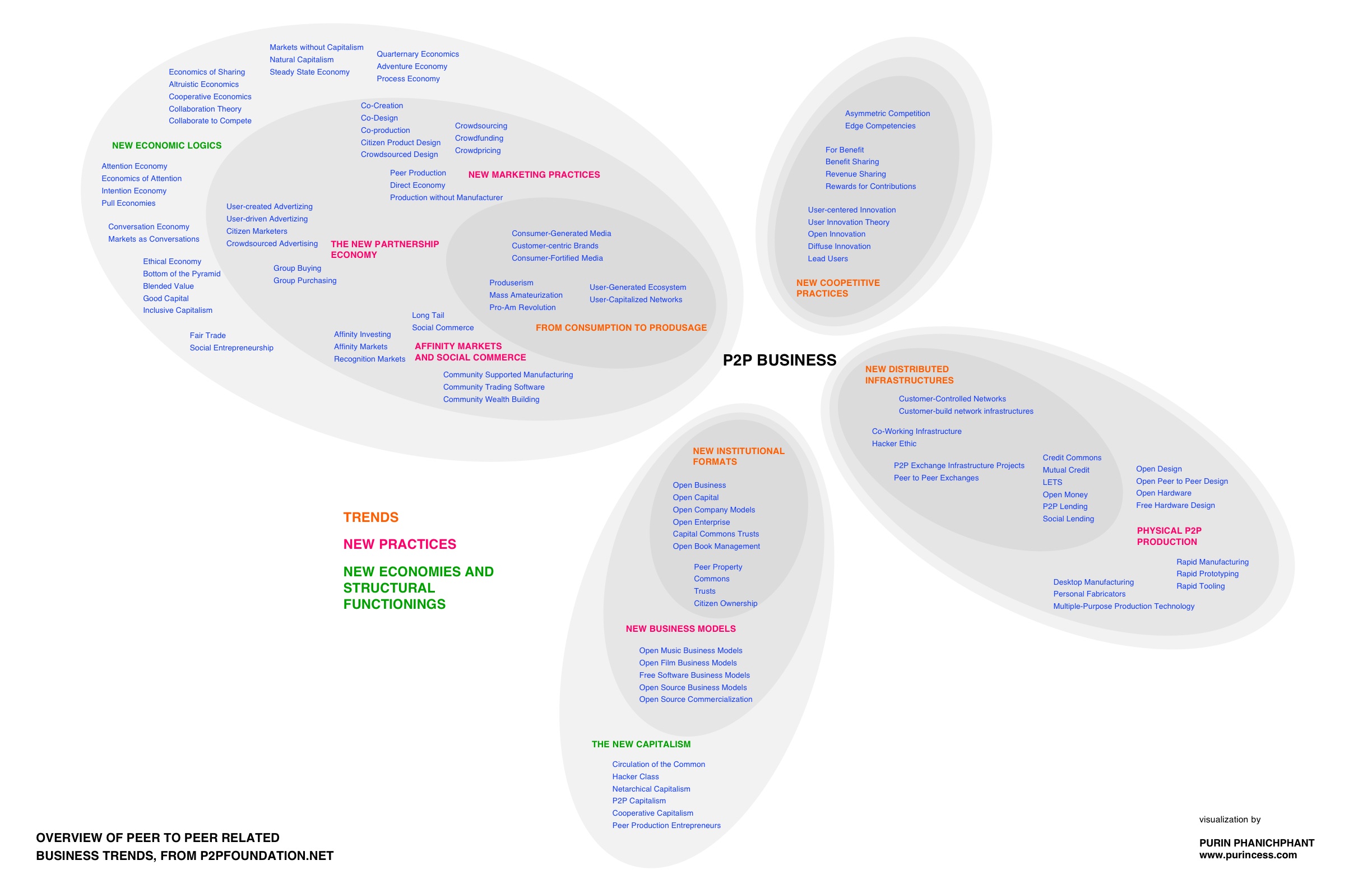
A map with a conceptual overview of the peer to peer business space. Every concept in the map is searchable via our wiki search box on the left.
Recommended reading:
- How Low Participation Costs make Peer Production Inevitable
- Markets are inefficient for non-rival goods. Josh Farley
- In peer production, the interests of capitalists and entrepreneurs are no longer aligned
- Can peer production make washing machines?. Graham Seaman.
Please note that the issue of physical peer production is monitored separately in this section
Short Citations
- When costs of participation are low enough, any motivation may be sufficient to lead to a contribution.- Michael Feldstein [1]
- Peer production is viable when: 1. capital costs (needed for production) fall far enough and 2. coordination costs fall far enough. Cheap computing and communication reduce both of these exponentially, so peer production becomes inevitable. - Anomalous Presumption [2]
- Working together as equals. Profiting from each others success. These two ideas represent a surprisingly radical redefinition of work. - Bernie DeKoven [3]
- We genuinely believe that radical sharing is a win-win for everyone. Expanding markets create new opportunities. - Tim Bray, Sun Microsystems [4]
- The best people (to solve any given problem) don't work for your organization. A corollary to this: if you don't have the best people working for you, you will fail. Use transparency and the marketplace to find the best people located outside your organization. - John Robb [5]
- Post-industrial modernization brings a fundamental shift in economic strategies, from maximizing material standards of living to maximizing well-being through life style changes. The "quality of experience" replaces the quantity of commodoties, as the prime criterion for making a good living - Alan Moore [6]
- The Implicit Goal of Attention Economy is: to tightly intertwine everyone at the level of mind. But that involves individuals seeking, obtaining and/or paying attention. - Michael Goldhaber [7]
- The peer producers are their own consumers. They get a better product by tapping into the knowledge pool. And they get a product that exactly fits their needs because they help design it. - Eric Schonfeld [8]
- In this new world, if it doesn’t spread, it’s dead. And those companies which seek to prohibit the manipulation and circulation of their content will find themselves cut off from the mechanisms which generate value in this new media economy. - Henry Jenkins [9]
Long Citations
Competing 'on top' of the Commons
"One of the best ways to stimulate competition, innovation and lower prices is for participants in a market to honor the commons (a shared pool of resources, a minimal set of safety or performance standards) and then to compete "on top" of the commons. Instead of being able to reap easy profits from monopoly control over something everyone needs -- say, a computer operating system like Windows -- a company must work harder to "add value" in more specialized ways." (http://onthecommons.org/node/1196)
- David Bollier
The Sharing Economy should be distinguished from the Monetary Economy
"... the quest for self-determination and meaningful and memorable experiences ultimately will hinge on people's understanding that they are not merely consuming a product, but that they are actually participating in a meaningful social process not guided by an extrinsic logic (profit), something that rather has intrinsic, or 'sovereign' value. I don't believe that these two can be fused into one
- Eric Kluitenberg, iDC archive [10]
Market Logic vs. Network Logic
"The philosophy that undergirds exchange also contrasts sharply across forms. In markets the standard strategy is to drive the hardest possible bargain in the immediate exchange. In networks, the preferred option is often one of creating indebtedness and reliance over the long haul. Each approach thus devalues the other: prosperous market traders would be viewed as petty and untrustworthy shysters in networks, while successful participants in networks who carried those practices into competitive markets would be viewed as foolish and naive... In a market context, it is clear to everyone concerned when a debt has been discharged, but such matters and not nearly as obvious in networks."
- Walter Powell - "Niether Market Nor Hierarchy: Network Forms of Organization" 1990
Markets without Money
"Money is a very important and useful medium of exchange for high-value, tangible products. For small-value, intangible products, the costs tend to exceed the value of the transactions—especially when you add in the overhead associated with making payments at a distance. Fortunately, human beings are clever. We’ve begun to find a variety of substitutes for money that work better."
- Tim Lee [11]
Social Commerce and the Intention Economy
"only 13% of consumers say they buy products because of their ads. Contrast that to 60% of small business owners in North America that say they use peer recommendations to make their buying decisions and over 70% of 18-35 year olds who report the same for their media purchases."
- Tara Hunt [12]
Key External Articles
- On the Economics of the Commons
- Circulation of the Common. Nick Dyer-Whiteford.
- Common Rights vs Collective Rights is an essay by Dan Sullivan in which he also explains the difference between Common Property and collective property.
- Can peer production make washing machines?. By Graham Seaman.
- On Information Economics
- JP Barlow, “The Economy of Ideas: A framework for patents and copyrights in the Digital Age”, Wired 2.03 (March 1994)
- E Dyson , “Intellectual Value”, Wired 3.07 (July 1995)
- K Kelly, “The Economics of Ideas”, Wired 4.06 (June 1996)
- On Open Source economics
- On the Economics of Participation
- Ten Principles for an Ethical Blogger Approach For Marketers
- Which tools to use for collaboration in business? - recommended overview table.
- The Open Business Guide
Key Internal Entries
Check the following priority entries:
- From consumption to produsage
- Produserism ; Mass Amateurization ; Pro-Am Revolution
- Consumer-Generated Media ; Customer-centric Brands ; Consumer-Fortified Media
- User-Generated Ecosystem ; User-Capitalized Networks
- The new partnership economy
- Affinity Markets and Social Commerce
- New marketing practices
- New Economic Logics
- Attention Economy ; Economics of Attention; Intention Economy ; Pull Economies
- Conversation Economy ; Markets as Conversations
- Ethical Economy ; Bottom of the Pyramid ; Blended Value; Good Capital, Inclusive Capitalism
- Fair Trade ; Social Entrepreneurship
- Markets without Capitalism ; Natural Capitalism ; Steady State Economy
- Economics of Sharing; Altruistic Economics ; Cooperative Economics, Collaboration Theory , Collaborate to Compete
- Quarternary Economics; Adventure Economy ; Process Economy
- New coopetitive practices
- New distributed infrastructures
- New institutional formats
- Peer Property ; Commons; Trusts ; Citizen Ownership
- Open Business; Open Capital ; Open Company Models ; Open Enterprise, Capital Commons Trusts ; Open Book Management
- New business models
- The new capitalism
Key Tags
P2P-Advertising; Crowdsourcing; Desktop Manufacturing; Distributed Capitalism; Innovation; Netarchical Capitalism; Open Source Commercialization; P2P Banking; P2P Business Developments; P2P Capitalism; P2P Economics; P2P Exchanges; P2P Management Developments; P2P-Money; P2P-Production; P2P-Property; Revenue Sharing; Social Commerce
Related Issues of P2P News
- Funding for peer production, Issue 103 of P2P News
- P2P and Market Exchange, practices, Issue 102 of P2P News
- P2P and Market Exchange, theory, Issue 101 of P2P News
- P2P Monetary Issues, bottom-up alternatives and top-down reform, Issue 99 of P2P News
- P2P Economic Governance, tools // P2P Capitalism, Issue 98 of P2P News
- P2P Economic Governance, theory, Issue 97 of P2P News
- P2P and Nature, theory, Issue 96 of P2P News
- Peer Production, Issue 92 of P2P News
- P2P Capitalism, Issue 89 of P2P News
- P2P Cooperation, Issue 88 of P2P News
- P2P Capitalism, Issue 87 of P2P News
- Alternative Monetary Theory, Issue 79 of P2P News
External Sources
Selected Wikipedia entries
- Altruistic Economics
- Genuine Progress Indicator
- Gross National Happiness
- Herman Daly
- Post Autistic Economics
- Uneconomic Growth
- Commons-based Peer Production
- Computer-supported cooperative work
- Gift Economy
- Public Domain
- GNU General Public License
- FLOSS
- Free Content
- Free software
- Open Source
- Open Source Initiative
- Long Tail
- Recommendation system
- Reputation
- Social software
Selected Podcasts
- Chris Anderson on the Long Tail
- Clayton Christensen on Open Source and Innovation in Business
- Doc Searls on Self-Forming Markets
- Doc Searls on the Intention Economy
- Geoffrey Moore on Open Source and Capitalism
- Jonathan Schwartz on the Age of Participation
- Michael Goldhaber on the Attention Economy
- Yochai Benkler on the Wealth of Networks
The P2P Business Encyclopedia
Pages in category "Business"
The following 200 pages are in this category, out of 1,920 total.
(previous page) (next page)1
A
- A2K Access to Knowledge
- Aaron Perzanowski and Jason Schultz on the End of Ownership in the Internet of Things Era
- Abundance
- Abundance - Typology
- Abundance Logic
- Abundance Logic vs Scarcity Logic
- Abundance vs. Scarcity
- Access Trumps Ownership
- Ad Blocking
- Adoption-Led Market
- Adriana Cronin-Lukas on How Blogging is Affecting Corporations
- Adventure Economy
- Advertizing by the Masses
- Affective Capitalism
- Affective Labor
- Affinity Earning
- Affinity Investing
- Affinity Markets
- Affinity Philanthropy
- Affinity Purchasing
- Agalmics
- Aggregate Abundance
- Aggregator
- Agile Development
- Agile Manifesto
- Alan Moore on Engagement Marketing
- Allocative and Creative Advantage
- Alternative Economy
- Alternative Media Cooperative
- Altruistic Economics
- Amazon
- Amy Vickers on the New Business of Collectivism
- Anarchist Economics
- Andrew McAfee on Enterprise 2.0
- Andrew McAfee on Entreprise 2.0
- Angel Economics
- Anonymous Market
- Anti-Quota Labor System
- Anti-Rivalness of Free Software
- Anti-Rivalry
- Anticommons Property
- Antigoras
- Antipreneur
- Antony Jenkins on the Uber Moment in Financial Services
- Apple’s App Store as a Closed Development Platform
- Appropriate Economics
- Art Gift Economy
- Artificial Markets
- Asset Sharing
- Asset-Based Community Development
- Associative Economics
- Associazione Imprese Software Libero - Italy
- Assurance Contract
- Asymmetric Accounting
- Asymmetric Competition
- At the Turning Point of the Current Techno-Economic Paradigm
- Attention
- Attention Curve
- Attention Economy
- Attention Standards
- Attention Trust
- Attention-Centered Economy
- Attraction Economy
- Auction Culture
- Audience Commodity
- Augmented Social Networks
- Authenticity
- Authorship Society
- Autonomous Decentralized Enterprise Model
- Axel Bruns
- Axel Bruns on Produsage
- Axel Bruns Vlogs on Produsage
- Axiological Economics
B
- B Corporations
- Banking
- Barter
- Barter Trade
- BarterBee
- Basic Income
- Bazar
- Because Effect
- Because Value Effect
- Beekeeper Model
- Beneficial Corporations
- Benefit Distribution Algorithm
- Benefit Redistribution Algorithm
- Benefit Sharing
- Benjamin Shestakofsky on the Inegalitarianism of the Startup Economy
- Beta Business Models in the New World
- Beth Kolko on the effect of Hackers and ProduSers on Creativity and Consumerism
- Betweenness and Closeness - Indicators
- Beyond GDP
- Beyond Information Abundance
- Beyond Western Economics
- Bibliography on Peer Production
- Big Shift
- Bill Witherspoon
- Bill Witherspoon on Open Book Management
- Binary Economics
- Biomimesis
- Biophysical Economic Theory
- Biophysical Economics
- Bitcoin - Business Aspects
- Bitcoin E-Commerce
- Blended Value
- Blobject
- Blockchain-Based Corporate V-Networks
- Blog Council
- Blue Economy
- Born Global Companies
- Born Online
- Borrowing Shops
- Bottom of the Pyramid
- Brakteaten Money
- Bram Cohen on Cultural Industries in the Age of Digital Reproduction
- Brewtopia
- Broadband for Barefoot Bankers
- Buddhist Economics
- Building a Whole Earth Economy through Right Relationship
- Building Social Business
- Building Trust in P2P Marketplaces
- Burst Economy
- Business Models
- Business Models for the Commons
- Business Models of Fab Labs
- Business Models to Support Content Commons
- Business of Sharing in the UK
- Business Social Media Impact Forecasting Simulator
- Buying Attention in the Digital Age
C
- C2C, B2C and the New Open 2.0 Business Models
- Calvert-Henderson Quality of Life Indicators
- Cambrian House Business Model
- Capital Commons Trusts
- Capital Partnership
- Capitalism
- Capitalism and the Ethical Economy
- Capitalism as if the World Matters
- Capitalist Commons
- Car Sharing
- Caritas in Veritate
- Carlo Vercellone and Matteo Pasquinelli on the Art of Rent
- Carlota Perez on Technological Revolutions and Financial Capital
- Carsharing
- CarSharing Association
- Case of a RepRap-Based, Lego-Built 3D Printing-Milling Machine
- Case studies of Co-creative Labour
- Catch Share Fishing
- Cellular Church
- Cellular Economic Theory
- Center for Adventure Economics
- Center for the Advancement of the Steady State Economy
- CEO Guide to Corporate Wikis
- CEO Guide to Widgets
- Chamber of Commons - Netherlands
- Chaordic Organizations - Characteristics
- Characteristics of Future-Proof Companies in the Age of the Collaborative Commons
- Chinese Motorcycle Industry
- Chris Anderson on Free
- Chris Anderson on How Web Video Powers Global Innovation
- Chris Anderson on the Emergence of Free
- Chris Anderson on the Freeconomy
- Chris Anderson on the Long Tail
- Chris Anderson on the New Manufacturing
- Chris Cook on Peak Credit and Open Capital
- Chris DiBona on the Economics of Open Source at Google
- Chris Lawer on Co-Creation in Business
- Circulation of the Common
- Citizen Banking
- Citizen Marketers
- Citizen Ownership
- Citizen Product Design
- Citizen Shipper
- Civil Corporation
- Civil Economy
- Civilizing the Economy
- Class of the New
- Classification of Crowdsourcing Approaches
- Clay Shirky on the End of the Audience
- Clearance Culture
- Cloud Company
- Cloud Law
- Cloudworker
- Club Goods
- Cluetrain Manifesto
- Cluster Theory of Open Source Economics
- Co-Creation
- Co-creation Communities
- Co-Creation Landscape
- Co-Design
- Coase's Penguin
- CoDesign International Journal of CoCreation in Design and the Arts
- Cognitive Capitalism
- Cognitive Capitalism and Entrepreneurship
- Colin Henderson on Blogging in the Banking World
- Collaborate to Compete