Introduction to the P2P Foundation Wiki Material about Commons Economics
This special section is dedicated to documenting a upcoming conference to be held in Berlin on May 22-24, 2014, on Commons-Oriented Economics [1].
- Our key document outlining how the commons economy needs a change in value regime, see: Value in the Commons Economy.
- A key read that contextualizes the shift towards an economy and society of the commons: Evolution of the Modes of Exchange
- The Common as a Mode of Production. Towards a critique of the political economy of common goods. Carlo Vercellone. [2]
- Also read: The Five Framing Conditions for a Commons-Oriented Economy, By Pat Conaty and Michael Lewis, which outlines:
- Resilience: Strengthening Our Capacity to Adapt
- Reclaiming the Commons
- Reinventing Democracy
- Constructing a Social Solidarity Economy
- Pricing As If People and the Planet Mattered
Context: the first global conference on Commons Economics
On May 22-24, 2013, in Berlin, the Commons Strategies Group co-organized the Economics of the Commons Conference, focusing on commons-oriented economics, with the support of the Heinrich Boll Foundation and the Charles Leopold Mayer Foundation.
See: Overview of the Economics of the Commons Conference. To give you an idea of what type of people may or should attend, see our draft list of Commons-Oriented Economists.
A useful warning from Marco Berlinguer:
"A commons approach to economy implies a redefinition of what is economy, what is value and a radical re-discussion about the measures (and the structures of power) which are embedded in the capitalistic money codes. And therefore economists as such aren't sufficient to cover all the implications."
In preparation, three continental workshops were held in the autumn period of 2012, you can find information on those exchanges here:
Contextual Citation
Towards a Social Insurance Based on the Commons
Peter Barnes:
"The present financial base of social insurance — payroll contributions by workers and employers — has essentially maxed out. Nor is it possible to supplement existing labor income by taxing it. So a 21st century system of economic security will have to be built on a new financing model, which I have proposed to be income from common wealth, in the manner of Thomas Paine and the Alaska Permanent Fund (see With Liberty and Dividends For All). Picture, then, a giant “common pot” into which flows money from multiple forms of common wealth and out of which flow monthly dividends to every American with a Social Security account. Such a pot could begin, as Social Security did, with a relatively small inflow and outflow, and grow over time as Americans become comfortable with it. Its funding sources could include fees on pollution of shared ecosystems and use of socially constructed financial infrastructure, as well as new money created in the manner Mellor proposes.
This system, anchored by the common pot, would serve three functions simultaneously. First, it would address the pressing need for lifetime economic security, a need that will only increase as automation and artificial intelligence replace more jobs. Second, it would create demand for more revenue sources which, if properly designed, would advance one of the key goals of the Great Transformation: internalizing the costs of destabilizing nature. Third and perhaps most importantly, it would supply the political juice for the first two functions. To paraphrase Mary Poppins, rising dividends from the common pot would become the sugar that helps the less palatable transformational pills go down." (comments to: http://www.greattransition.org/publication/money-for-the-people)
Important Pages
- Draft page on Commons-Oriented Economists
- Formal alphabetical directory of Economists of the Commons
Documentation:
- ABC of Commons Economics: material by topic, a dictionary for commons-oriented economics
- Articles on Commons Economics
- Books on Commons Economics
- Cases in Commons Economics
- Discussions on Commons Economics: a collection of more informal material
- Events on Commons Economics: seminars, conferences, etc ..
- Videos on Commons Economics
- Audio Podcasts on Commons Economics
A proposed institutional framework for the Commons at different levels of scale
- In the book, The Power of Neighborhood and the Commons, author PM makes the following proposals:
Discussion
Roberto Verzola:
"Let me go back to a common phrase "working in harmony with nature".
I will now extend it a little bit: "working in harmony with the nature of nature".
I will further modify that as follows: "working in harmony with the nature of things", where "nature" is one of those "things", the other being "non-living material goods", and the third being "non-material goods".
- "working in harmony with the nature of living goods"
- "working in harmony with the nature of non-living material goods"
- "working in harmony with the nature of non-material goods"
- "production methods in harmony with the nature of living goods"
- "production methods in harmony with the nature of non-living materials goods"
- "production methods in harmony with the nature of non-material goods"
- "modes of sharing in harmony with the nature of living goods"
- "modes of sharing in harmony with the nature of non-living materials goods"
- "modes of sharing in harmony with the nature of non-material goods"
- "forms of ownership, control and access in harmony with the nature of living goods"
- "forms of ownership, control and access in harmony with the nature of non-living material goods"
- "forms of ownership, control and access in harmony with the nature of non-material goods"
Because living goods (agriculture) are qualitatively different from non-living material goods (industry), which are in turn different from non-materal goods (information), we can expect differences to show up also in the production methods, modes of sharing, and forms of ownership, control and access.
We ignore these differences at our own risk. Today the most common problem is the misapplication of the industrial paradigm in agriculture (mechanization; the whole agrochemical industry; genetic engineering) as well as its misapplication in the information sector (products of intellectual work as private property). But it may be equally disastrous to misapply policies for non-rivalrous goods to rivalrous goods. I think this was a factor in the collapse of the Eastern bloc." (adapted from Commoning mailing list, January 2011)
The potential role of the Crypto Economy for Commons Economics
Excerpted from Dick Bryan and Akseli Virtanen:
(see his Criteria to Evaluate the Commons Capability of Crypto-Economy Projects)
- 1. "Programmable organizations enable production to be organized in a way that makes social criteria the rationale for production; not a constraint on it."
- 2. "The rise of ‘networks’ as modes of corporate organization breaks down the conventional means that differentiate one corporation from another and challenges the principle of ‘competition’ as the driver of corporate rationale. These are both issues that feature prominently in decentralized applications."
* 3. Mechanisms, like tokens, that allow surplus value to be retained by the workers, not capital.
" Changes in the nature of work (precarization, casualization, subcontracting, the rise of the gig economy) see workers carrying greater risks and break down the attachment of work and living standards to employment. There is growing interest in alternative ways of organizing work." [5]
4. "the real potential is cryptocurrencies as units of account: as modes of measuring economic activity that are conceived differently from those intrinsic to fiat money. Fiat money has become tied to conventional framings of profit and loss, income and expenditure, and a market-centred calculus. Non-fiat monies have the potential for developing new ways to calculate economic activity; ways that represent different social and economic values, and measure performance by criteria other than profit. Think about it for a moment. The unit of account potential signals the importance of the crypto economy developing ways (not a singular way, but coin-specific ways) of accounting and measuring the activities supported by each token. We see this as central to giving tokens a material basis in the crypto economy; not just leaving them as speculative stores of value. .... "Exchange is often between parties of unequal power, so mutual gain cannot be presumed. An important issue of the crypto economy is how blockchain can and cannot countermand asymmetrical power in trade. We see blockchain not facilitating frictionless markets but rather frictionless capital: distributed capital."
[6]
Source: https://medium.com/econaut/what-is-a-crypto-economy-155bdbc4ab1d
Citations
The historical pivot for the P2P Mode of Production
"We’re seeing something that is historically shocking—the reduction to zero of the cost of an especially valuable part of capital, which materializes directly knowledge (free software, free designs, etc.). And above all we see, almost day by day, how the optimum size of production, sector by sector, approaches or reaches the community dimension.
The possibility for the real community, the one based on interpersonal relationships and affections, to be an efficient productive unit is something radically new, and its potential to empower is far from having been developed. This means that we are lucky enough to live in a historical moment when it would seem that the whole history of technology, with all its social and political challenges, has coalesced to put us within reach of the possibility of developing ourselves in a new way and contributing autonomy to our community.
Today we have an opportunity that previous generations did not: to transform production into something done, and enjoyed, among peers. We can make work a time that is not walled off from life itself, which capitalism revealingly calls “time off.” That’s the ultimate meaning of producing in common today. That’s the immediate course of every emancipatory action. The starting point."
- David de Ugarte [7]
Key Resources
Visualizations
-
Ultimate Political Economy
Ultimate Political Economy
Source: http://steadystate.org/an-economics-fit-for-purpose-in-a-finite-world/?

The Commons Economy as the evolutionary step ?
From the Presencing Institute:
http://p2pfoundation.net/images/Economic-evolution.png.jpeg
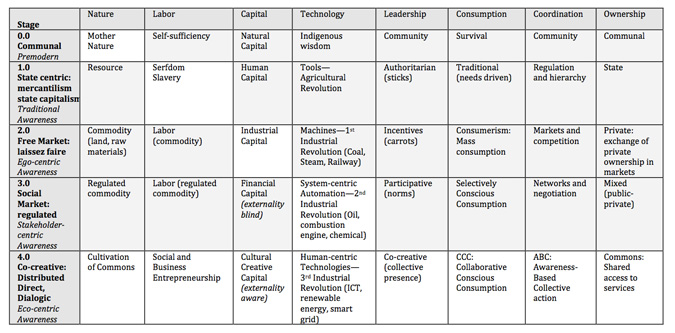

From encommuns.org: Graph, part of Table for the Analysis of Commons Projects

Key Articles
See: Articles on Commons Economics
- Dmytri Kleiner: Flawed Circuits of Value in the Lulz Economy
- Esko Kilpi: From Firms to Platforms to Commons.
- Tiberius Brastaviceanu on Why We Need a Contribution Accounting System
Nature as a Commons
- How Currency Value Should Be Connected to the Carrying Capacity of Non-Renewable Resources. By James Quilligan.
Labour as a Commons
- Linking Labour and the Commons Internationally
- From Labour as Commodity to Labour as a Common. Draft of an article by Hilary Wainwright
Money as a Commons
- Understanding the Money Commons
- How Currency Value Should Be Connected to the Carrying Capacity of Non-Renewable Resources. By James Quilligan.
More:
- What's Wrong with the Current Monetary System, by Mark Joob. Excellent summary in 10 points.
- Stefan Meretz on Demonetization
- Open Money as a Commons: Blogtalkradio conversation with Michael Linton and Ernie Yacub.
Key Books
See: Books on Commons Economics
- Elinor Ostrom's Rules for Radicals. Cooperative Alternatives Beyond Markets and States. Pluto, 2017
- The Resilience Imperative. Cooperative Transitions to a Steady-state Economy. by Michael Lewis & Pat Conaty: Reclaiming the Commons is one of the five framing elements that make up the spine of the book. The others – resilience, economic democracy, the social solidarity economy and pricing externalities.
- Report: Value in the Commons Economy: Developments in Open and Contributory Value Accounting. By Michel Bauwens and Vasilis Niaros. Heinrich Boll Foundation, 2016. [8]
Key Policies
Jose Ramos: Policies for a Transnational Commons Economy
Key Projects
- Encommuns.org in Lille, France
- The Mutual Aid Network for Madison, Wisconsin and beyond
- Commons-Oriented Decentralised Programmed Organisations, i.e. cDPOs "are frameworks to bootstrap, develop & sustain commons projects"., aka, the commons-oriented version of DAO's. More info in the article: Programmed Decentralised Commons Production. [9]
Key Reports
- Value in the Commons Economy: Developments in Open and Contributory Value Accounting. By Michel Bauwens and Vasilis Niaros. Heinrich Boll Foundation, 2016. [10]
- * Report: Re-imagining Value: Insights from the Care Economy, Commons, Cyberspace and Nature. By David Bollier. Commons Strategies Group in cooperation with the Heinrich Böll Foundation and David Graeber. March 2017.
Key Videos
- the 13 videos recorded by Remix the Commons: Economics (and the) commons - ECC Berlin 2013
Directory of Commons-Oriented Economists
To Do List:
Hazel Henderson ; Kevin Carson, Enrico Grazzini; Alanna Harzok; Tommaso Fattori ; Denis Postle ; Riane Eisler ; Herman Daly
Adelheid Biesecker ; Maristella Svampa, Argentina ; Magdalena Leon, Ecuador ; Achille Bembe [12]; pavan sukhdev
Suggested by David Bollier: Tim Jackson, Bernard Lietaer, Jim Boyce, Josh Farley -- and not just economics-minded commoners like Wolfgang Hoeschele, Brett Frischmann; Jerry Michalski, Jem Bendell
First list of confirmations to conference: Allan Butcher, Sophie Anita Ball, Daniel Dahm (I plied to him already), Zofia Lapniewska, Margrit Kennedy, Kevin Hansen, Richard Rosen, Marvin Brown, Egardo Lander, Bernardo Gutierrez, Smari McCarthy, Wolfgang Hoeschele, Orsan Senalp, Jorge Machado
A
B
- Marvin Brown on the Civic Economics of the Commons
- Ellen Brown on the Economics of the Credit Commons
- Allen Butcher on Allocation Mechanisms for Community Economics
C
- Allain_Caillé, Revue du Mauss: gift economics
H
J
R
S