Open Value Network Model: Difference between revisions
No edit summary |
|||
| Line 1: | Line 1: | ||
=Background= | |||
This organizational model instantiates commons-based peer production. The model emerged from practice, within the [http://www.sensorica.co SENSORICA] community and network. To know more, go to the [http://valuenetwork.referata.com/wiki/Main_Page OVN wiki]. | |||
=Description= | =Description= | ||
Revision as of 19:28, 1 November 2016
Background
This organizational model instantiates commons-based peer production. The model emerged from practice, within the SENSORICA community and network. To know more, go to the OVN wiki.
Description
Apostolis Xekoukoulotakis:
"The OVN model proposes that each production process publishes all information about its internal functioning. That allows production methods to be copied. Provides accountability. Public view allows people to propose better solutions and to detect errors sooner. Moreover, ecological and other externalities are easily Identifiable.
The OVN model also proposes that information about the supply chains be also visible. All production processes should provide information about their product and the requirements they have in tools, materials and human resources as well as the current suppliers and customers.
The ability to search and analyze these data allows for different groups that were otherwise isolated and small to interconnect. This has the profound advantage that these small groups can cooperate, coproduce value and thus be able to compete with traditional companies with a higher number of capital assets. Moreover the information about the supply chains allows people to suggest more efficient supply chains and at the same time bypass the supply chain middlemen entirely." (http://commonsfest.info/en/2015/anichta-diktia-axias/)
Characteristics
"The open value network model departs from capitalism for 3 main reasons:
- No economic cast, no division between owners and workers, between those who own the means of production and those who provide work. The commons takes care of that.
- No clearly defined frontier between the system of design-production-distribution and the market, the system rewards every contributor to value creation in proportion to his/her contribution. The value accounting system takes care of that.
- Reappropriation of labor. Active affiliates who are involved in value creation are not exchanging their labor for wages, they are in fact accumulating equity, which gives them rights to the future revenue generated by exchanging the value they create with the market. Thus the individual is always the owner of his work.
The value accounting system allows value networks to go beyond the gift economy AND beyond the candy economy." (http://multitudeproject.blogspot.ca/2013/04/open-source-hardware-meets-p2p-economy.html)
Discussion
Tiberius Brastaviceanu:
"What we see in the case of OSHW is a greater integration between a commercial entity and its market. Traditional commercial entities maintain provider-consumer type of relations with their markets: some "smart" individuals within the firm study what consumers might need, pass that to a team of engineers to make it, and put it for sale with a team of marketing wizards who will make almost anything look like the perfect fit. If the firm was right about the need, which is not always the case, customers pay for it and take it, and ask for service if needed. Service is provided by the commercial entity in exchange of customer loyalty. In this approach, the consumer is educated about what he needs and wants, after the "smart guys" have made the market study, decided on the general need, and offered a one-fit-all solution. This is obviously the extreme case, or what was widely practiced 20-15 years ago. Today, traditional corporations build communities around their brands, and they try to absorb more feedback from their consumers. In the case of OSHW, individual consumers drive design and development.
This integration between the commercial entity and the market in the prevalent OSHW models is made possible by the internet technology. But as we saw above, there is still a clear distinction between the commercial entity and the community. For example, a community member who proposes a new design that becomes commercially successful is not rewarded with a fair share of the profits made by the commercial entity. I call this the "candy economy", meaning that the members of the community around a OSHW company stick with it and contribute mostly for intrinsic motivations, and a small present (a candy) or a token of recognition from time to time.
Is this division between the commercial entity and the community necessary? Or is it an impediment for a better arrangement?
The open value network model abolishes the distinction between the commercial entity and the community!
The open value network is a model for commons-based peer production.
See graphic via http://2.bp.blogspot.com/-fp3YPAw6icQ/UWsYwdnoYeI/AAAAAAAAGDw/GTexHmVUkgY/s1600/organizational+structure.JPG
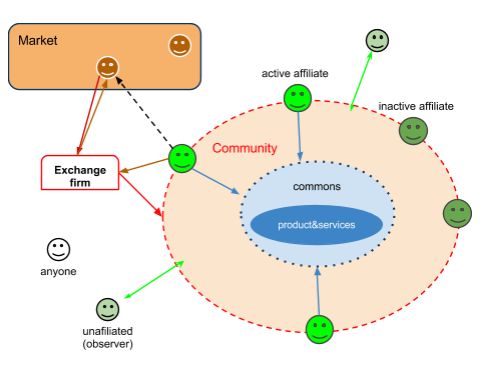
The diagram above depicts the structure of a value network. The physical and the virtual infrastructure, as well as the tools and the equipment used in R&D and in production are part of a pool of shareables, legally owned by a custodian, which is bound by a contract to act in the interest of the community, obeying a set of predefined rules set by the community. All the information and the knowledge generated by the value network become part of the commons (there is no intellectual property). Affiliates (agents) rely on their know how to create value (products), using these resources. This value (products) is exchanged on the market for some form of revenue. The revenue is redistributed among all affiliates in proportion to their contributions, using a value accounting system. The barrier to participation to value creation processes is very low. In that sense, the value network is open. Value creation is so widely defined that it encompasses activities usually performed by members of the commercial entity and the community, in the prevalent OSHW model cited above. Therefore, the two structures, the community and the commercial entity are merged together at the level of value creation.
The open value network model distinguishes between different types of agents, based on their degree of involvement/participation. Thus, we can distinguish between active affiliates (those who take part in value creation) and unaffiliated observers (those who know what's going on in the value network). If we go back to the prevalent OSHW model cited above, we can say that the owners and the employees of the commercial entity, as well as the community members who provide feedback and new design ideas, or who actively propagate information about products are ALL active affiliates.
We also need to note that active affiliates are those individuals who participate in value creation AND who decide to log their contributions within the value accounting system. Participation in the value accounting system is NOT mandatory. Someone can elect to contribute to the value network without expecting something in return. Thus, the open value network integrates a gift economy with a market-oriented economy.
That is all fine on the value production side, but what about the distribution side, or the market side? All the transactional logistics (for the exchanges between the value producing network and its market) and the legal aspects associated with it are moved into what sencoricans call the "Exchange firm", which can be embodied as a non-profit, with the sole purpose of serving the value network.
So why is the open value network a menace to current OSHW business models? Because by abolishing the distinction between the commercial entity and the community, value networks like SENSORICA threaten to drain these communities associated with OSHW-based firms of their talent!" (http://multitudeproject.blogspot.ca/2013/04/open-source-hardware-meets-p2p-economy.html)
What does radical openness mean?
Apostolis Xekoukoulotakis:
"Radical openness means that any person is able to join a production process. The only constrains are there to protect the shared resources, the commons. This has a profound effect on the way the production process works.
From an economic point of view, radical openness and radical transparency allows engagement to the production processes by a great number of people that can produce value in amounts that could have never before being conceived(wikipedia, wikispeed).
From an ethical point of view, the production process tries to maximize product value rather than profits. At the same time revenue is distributed to a greater number of people. Because everyone is free to join and cocreate value, in an open and democratic way, people love to work, they work on things they like or are good at." (http://commonsfest.info/en/2015/anichta-diktia-axias/)
More Information
- Network Resource Planning (NRP), which is ERP (Enterprise Resource Planning) for networks.
- See also Wezer and Ryaki