Centralization vs Decentralization Historic Cycle
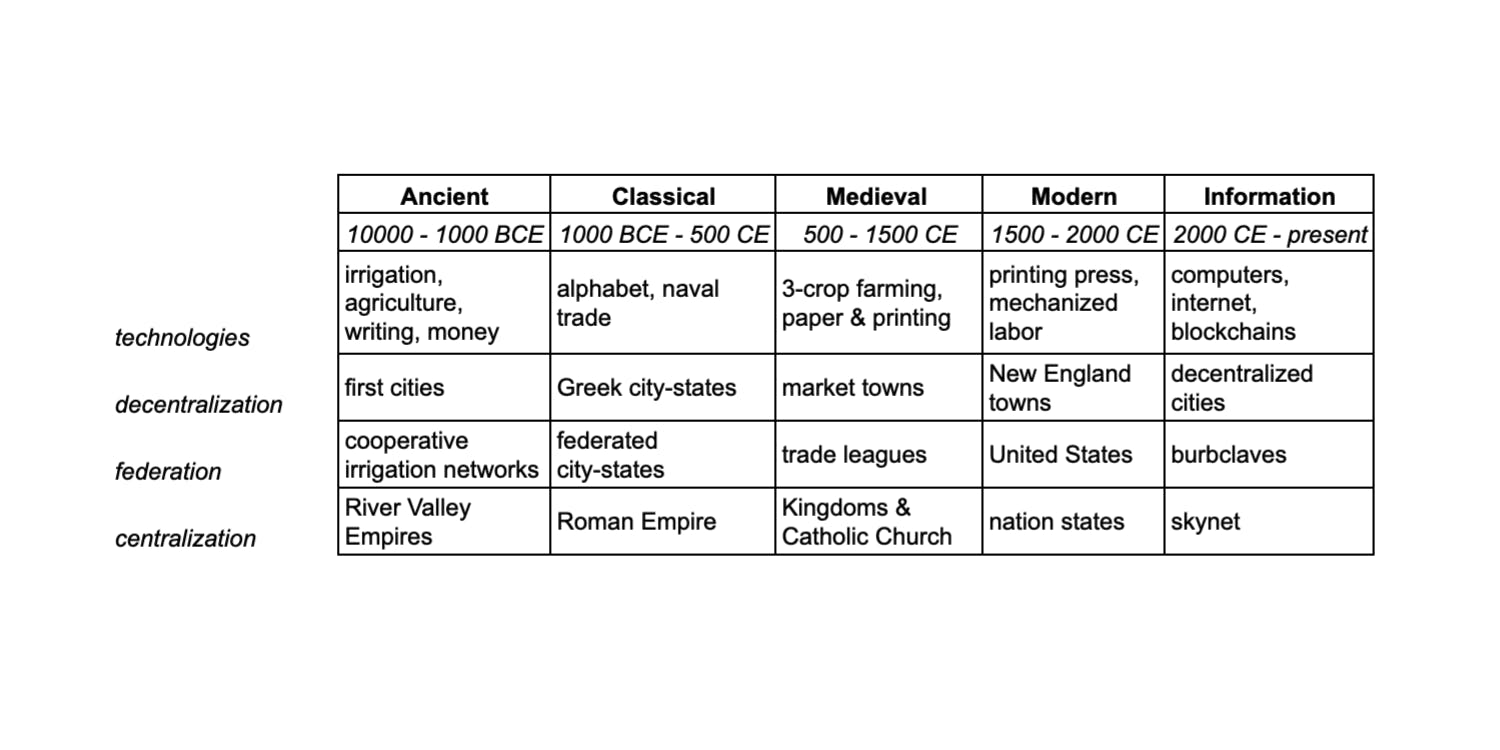
= "cycles of decentralized cities and centralized states": Graphic (table) at https://mirror-media.imgix.net/nft/3yNxZaUhN8C4mMZBTjwJf.png?h=null&w=null&auto=compress
Contextual Quote
"There’s only two ways to advance civilization: bundling and unbundling."
- Jim Barksdale [1]
Description
Jon Hillis:
"Once in a while, in the long arc of civilization, a new set of coordination technologies come along and change everything. By allowing small groups of humans to better cooperate in the collective management of resources, these technologies redefine power structures and lay the bedrock of a new civilizational era.
Humans are social creatures—we got to where we are by bootstrapping coordination tools into complex organizational structures. That bootstrapping process follows a repeating pattern of decentralization and centralization over the course of the rise and fall of civilizations:
- Technologies for coordination and communication rapidly bootstrap themselves into usefulness by civilization
- These new coordination technologies allow humans to form effective local, decentralized governance structures (eg cities)
- Ultimately, the federated network of decentralized governance is overpowered by a more efficient centralized structure of sovereignty
- The centralized sovereign structure eventually collapses under its own weight, restarting the cycle by creating a governance vacuum".
(https://creators.mirror.xyz/s9h4_PQAcJyqgC0rnsWjw9geU2wJs-IBPXIzHhgi-P8)