Ownership Control Matrix: Difference between revisions
No edit summary |
No edit summary |
||
| Line 4: | Line 4: | ||
= | =Description= | ||
Allen Butcher: | |||
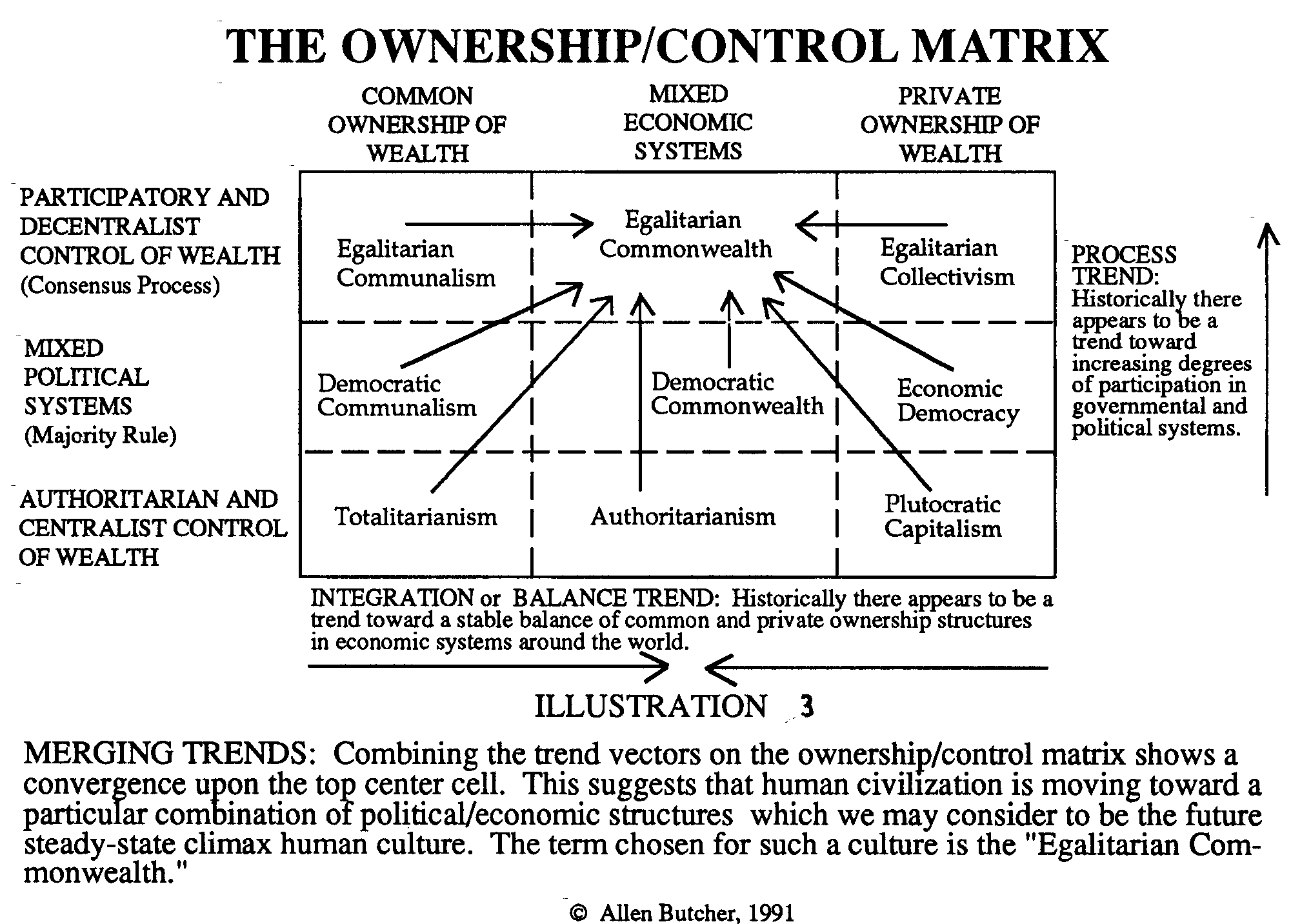
"Ownership/Control Matrix—a two-dimensional model of political-economic structures, with common to private ownership on the horizontal axis and participatory to authoritarian political structures on the vertical axis, and a mid-range for each, resulting in nine different political/economic systems; also called "Intentional Community Matrix," "Communitarian Matrix," "Political/Economic Matrix" (1991)" | "Ownership/Control Matrix—a two-dimensional model of political-economic structures, with common to private ownership on the horizontal axis and participatory to authoritarian political structures on the vertical axis, and a mid-range for each, resulting in nine different political/economic systems; also called "Intentional Community Matrix," "Communitarian Matrix," "Political/Economic Matrix" (1991)" | ||
=More Information= | |||
See also the [[Political Spiritual Matrix]] — a two-dimensional model combining forms of spiritual beliefs (see the spiritual/economic matrix) on the horizontal axes with forms of governance from participatory to authoritarian on the vertical axis; one of three matrices in the communitarian relationships model (1991) | |||
Revision as of 09:36, 3 August 2011
= charts the evolution towards more participatory governance and property systems
URL = http://www.culturemagic.org/Images/EgalitarianCommonwealth.gif
Description
Allen Butcher:
"Ownership/Control Matrix—a two-dimensional model of political-economic structures, with common to private ownership on the horizontal axis and participatory to authoritarian political structures on the vertical axis, and a mid-range for each, resulting in nine different political/economic systems; also called "Intentional Community Matrix," "Communitarian Matrix," "Political/Economic Matrix" (1991)"
More Information
See also the Political Spiritual Matrix — a two-dimensional model combining forms of spiritual beliefs (see the spiritual/economic matrix) on the horizontal axes with forms of governance from participatory to authoritarian on the vertical axis; one of three matrices in the communitarian relationships model (1991)