Robert Kegan Model of Adult Development
Description
David Chapman:
1.
"My conceptual framework draws on Robert Kegan’s model of adult cognitive, affective, and social development.
Kegan describes three stages of adult development (numbered 3, 4, and 5). We could call them pre-rational, rational, and meta-rational. These stages are distinctive, internally consistent, relatively-well-functioning modes for organizing one’s thinking, one’s self, and one’s relationships. They might be described as “islands of psychological stability.” To progress from one island to the next, you must cross a heaving sea of psychological confusion, in which the previous mode no longer seems functional, but you cannot yet operate in the next mode reliably. These stage transitions are emotionally and cognitively difficult, and typically take several years, during which one may think, feel, and act inconsistently.
Ideally, a society and culture provides “bridges” of support from one stage to the next. To some extent, ours does. However, Kegan pointed out that we have allowed the bridge from stage 3 to 4 to fall into disrepair. We are not adequately teaching young adults how to be rational, systematic, or modern. This is the central theme of his In Over Our Heads: The Mental Demands of Modern Life."
(https://metarationality.com/stem-fluidity-bridge)
2.
“Kegan recognized that ethics is not an autonomous domain, but derives from the way we construct our selves; the way we understand romantic, family, and work relationships; and our general cognitive capacity. In empirical studies, he and others found that all these progress in sync through a series of five stages, similar to the ones Kohlberg had demonstrated for ethical reasoning ability. Each stage has a more sophisticated and more accurate understanding of self and other, which makes more sophisticated and accurate ethics possible.
Building on Kegan’s work, other theorists have suggested that the ways societies progress through increasingly sophisticated cultures and social organizations fits the same five-stage model. (I discuss this in “The history of meaningness.”)
Kegan’s model is, I believe, the most sophisticated and useful account of ethics available. It is not complete or conclusive. Like every conceptual scheme, it is not Ultimate Truth. It’s a tool that’s useful in many situations; inapplicable in many others; and misleading in some.
This summary of Kegan’s work cannot be read as a casual blog post. It is better to approach it like a section of a textbook; you may need to read it slowly and carefully. The model is conceptually complex and difficult; to explain it properly takes a book. I hope some readers will find this summary makes sense, and that others will be motivated to read Kegan. His two relevant books are The Evolving Self, which covers all the stages, and In Over Our Heads, which is about the difficulty and importance of the stage 3 to 4 transition specifically. Alternatively, you could read more detailed notes and quotes from The Evolving Self here.
Kegan changed some theoretical details, and most of his terminology, between the two books. My presentation is mostly consistent with both books, but I am using my own terminology, which is different from both. I’ve made small changes to the account of stage 5, partly based on my understanding of Vajrayana, and in the light of changes in Western culture and society since 1994, when In Over Our Heads was published."
The Stages
David Chapman:
1.
"Stages 3 and 5 both tolerate contradictions, but of different types and in different ways.
Stage 3 does not feel a need for rational justifications, and mostly doesn’t have the capacity to use them; so it mostly doesn’t even notice logical contradictions, and isn’t bothered by them when it does. However, stage 3 can be highly intolerant of contradictory value judgments, because they threaten community harmony.
Stage 4 finds contradictions within its system a fundamental problem, and tries to eliminate them one way or another. Eventually, if contradictions cannot be eliminated from the system, it must be replaced. Stage 4 wants to find the right system, and if two contradict, that shows one is wrong.
Stage 5 recognizes the value of sorting out contradictions within a system, and retains stage 4’s ability to do so. However, it doesn’t expect any system to work perfectly, so it tolerates internal contradictions if they appear relatively unproblematic. Stage 5 entertains multiple systems, and is comfortable with contradictions between them, because systems are not absolute truths, only ways-of-seeing that are useful in different circumstances. Stage 5 is uniquely comfortable with value conflicts, since (unlike both 3 and 4) it does not take any value as ultimate."
(https://metarationality.com/stem-fluidity-bridge)
2. The stages of adult development
"A stage is a capacity, or competence: the ability to relate to meaning in a particular mode. If you are at a later stage, you also have the ability to operate in any of the earlier modes; but not vice versa. Stage transitions are gradual; they take many years. During a transition, one is sometimes able to function in the more sophisticated mode and sometimes not. Each stage transition reorganizes the self/other relationship. It relativizes what had been “subject”—the nature of the innermost self—and turns it into mental objects. In the new stage, a new sort of subject emerges; a new form of innermost self. The new subject organizes and acts upon and through mental objects that had previously been “subject.” (That probably sounds extremely abstract; it will become clearer with examples. I’m pointing it out here because it’s how each transition works, so it’s something to look out for when understanding how those happen.)
The self-interested mode (stage 2)
Here the subject (self) is a collection of short-term practical interests. One recognizes that other people have their own interests (desires, agendas), which you have to take into account.
Ethics in this mode is “instrumental”: aimed at satisfying your own needs, while working with or around other people’s. Relationships are “transactional”: transient alliances for mutual benefit. An exchange is “fair” if it is of equal value (as seen from your own perspective).
Most (but not all) Westerners make the transition from stage 2 to stage 3 during adolescence.
The communal mode (stage 3)
Here personal interests are relativized. They move from subject to object: you no longer are your collection of interests, you have interests. They are subordinated to, and are organized by, relationships. You are in relationships; and, tacitly, you find yourself defined by them.
Stage 3 develops a more accurate, more complex understanding of the self/other boundary. For stage 2, other people are meaningless unless they directly affect one’s immediate interest. For stage 3, “the other’s point of view matters to us intrinsically, not just extrinsically as a means of satisfying our more egocentric purposes.”4 Epistemologically, the communal mode develops the ability to “put oneself in the other person’s shoes,” which is cognitively impossible in the self-interested mode. Stage 3 also becomes intensely sensitive to “what others think of me,” which stage 2 is mostly oblivious to.
From stage 2 to stage 3, there is a move from excessive separation to excessive embeddedness. The mode tends to commingle what is properly self and what is properly other into a unified experience. One takes on other people’s emotions, values, interests, and situational experiences without clearly identifying them as someone else’s. This mixture becomes the subject: that is, the unthematized innermost self.
The prototype relationship is the “school chum”; developing intense peer friendships is what typically drives the transition to the communal mode. Relationships are normatively symmetrical: between equals; and reciprocal: each provides the same kind of support for the other. (This is the simplest form of enduring relationship.) Because relationships have no structure, they have no defined limits; you are potentially infinitely responsible to everyone you are in relationship with.
Communal ethics seek harmony within a homogeneous social group. That is maintained by empathically monitoring others’ needs and aligning your intentions toward them. Equality here means that everyone’s needs deserve to be heard; unlike stage 2, it does not necessarily imply an exchange of equal value, because some people need more than others. Decision-making is ideally by consensus, after everyone has shared their feelings. Also, you should obey community taboos and shibboleths, even when they are unjustified and senseless. Violating them upsets people, which is not nice. Living up to what other members expect from you is good by definition—because “who I am” is “how people feel about me.” The Golden Rule is a summary of communal ethics; note its perfect symmetry!
The communal mode also recognizes asymmetrical relationships of biological necessity, i.e. family and heterosexual pair bonds. Here the ethical imperative is to fulfill the role in the conventional prescribed way: being a “good” child, parent, or spouse. Fulfilling the role consists largely in having the correct feelings. Throughout communal ethics, emotions dominate other considerations.
Romantic relationships tend toward fusion, eliminating any emotional separation or difference in values.
The communal mode generally rejects asymmetrical relationships other than those of biological necessity. From its point of view, asymmetry implies that one party is failing to take the other’s experience into account, which could only be motivated by stage 2 selfishness.
Stage 3’s limitation is that it cannot resolve conflicts between responsibilities to different relationships. If one person wants you to do something, and another person wants you to do something different, there is no good basis for decision, because relationships have no internal structure; they consist simply of sharing experience.
Here is the experience of stage 3 failing to cope with irreconcilable expectations:
That impossible feeling of having to be in several places all at the same time, that feeling of being ripped apart, or being pulled in several directions, the feeling of wanting everyone you love to be happy, or even feeling you could make them all happy—if only they would cooperate.
In practice, you choose on the basis of whose feelings you feel most strongly at the moment you are forced to decide. This is often whoever happens to be there at the time, or whoever is best at displaying intense feelings. Social groups based in the communal mode tend to be dominated by people with personality disorders, who get their way by emoting histrionically.
People in stage 3 seem irresponsible and unreliable to people in stage 4. They frequently fail to do what they agreed to do—because “something came up.” From the communal point of view, that was being responsible: they were dealing with the thing that came up, which was that someone from some other part of their life wanted something else done. Stage 4 might say “yes, but that thing wasn’t your problem, and it just came up, whereas you had previously agreed to do what I wanted.” This merely sounds like stage 2 selfishness to stage 3: prioritizing my wants over the third person’s. Stage 3 cannot hear that there can be structural reasons, not just feelings, for prioritizing one responsibility over another.
“That’s not my problem” can be stage 2 language or stage 4 language; it is not stage 3 language. Stage 3 cannot avoid taking on anything that “comes up,” i.e. the transient feelings of anyone you are in relationship with. In effect, you try to be responsible for everything.
However, if you are responsible for everything, you cannot actually be responsible for anything. You cannot be held accountable to any specific responsibility.
The communal mode is characteristic of pre-modern (“traditional”) cultures. It’s impossible to base a large-scale society on the communal mode, because it’s so ineffective at coordinating complex group activities. (If individuals frequently fail to do their specific, agreed tasks, nothing can get done.) Modern societies are based on the systematic mode (stage 4).
In modern societies, stage 3 is developmentally appropriate for adolescents. It is not adequate to fully cope with what modern societies demand of adults. Stage 3 adults in the West are developmentally traditional people6 living in a modern world7—and that causes friction. Because Western adults do all have to deal with stage 4 systems (especially in employment), everyone develops coping strategies, and everyone has some intellectual understanding of how they operate. However, in the communal mode, systemic logic seems alien and emotionally unacceptable. This can be ideologized. Anti-capitalism, for instance, is often motivated by a stage 3 rejection of the asymmetrical, structured relationship of employment. (However, it can also be motivated by a stage 4 systemic understanding of how capitalism works, and why it doesn’t work well enough.)
• For stage 2, you show up to work on time because if you don’t, you might be fired, and then you’d have to find another job, which would be a hassle, and you’d lose pay in the meantime. If you do show up, you’ll eventually be promoted, so you’ll get paid more.
• For stage 3, you show up to work on time because your coworkers would be upset with you if you were late; or because your spouse would be upset with you if you got fired; or because you might miss a pay raise that would mean a better quality of life for your children.
• For stage 4, you show up to work on time because that’s your job.
The systematic mode (stage 4)
Here relationships are relativized. They move from subject to object, and are subordinated to, and organized by, a system. You no longer are in relationships that define you; you have relationships. You no longer are a stream of transient emotional experiences; you have experiences.
You are a system that defines you. Here the self is a structure of enduring principles, projects, and commitments. You are “self-authored”: you choose your own principles, projects, and commitments.
Others are understood as having chosen their own principles, projects, and commitments. They have experiences, so those are not your experiences. This does not mean that you are oblivious to or ignore others’ experiences (as in stage 2). It means that you are not flooded by them, and can evaluate whether or not to respond to them, and how best to do so.
Systematic people relate mainly on the basis of each other’s principles, projects, and commitments, rather than their feelings. To stage 3, that sounds cold and distant, but for stage 4, it means seeing the other person for who they really are. Emotions are just something people have, from time to time. Those need to be dealt with, but should not be taken too seriously. Relating to the other person’s principles, projects, and commitments means supporting what they most care about in the longer run.
A romantic relationship between systematic people not only tolerates, but respects, and actively supports, their differing values and projects. That is what it means (for stage 4) to be actually in a relationship with another person, rather than losing both your selves in a warm bath of shared feelings.
Social groups are also understood as systems. Whereas stage 3 advances over stage 2 by being able to take the perspective of one other person, or of a homogeneous group of others, stage 4 has the capacity to take the perspective of an entire system of differentiated, interlocking roles that have asymmetrical, structured relationships with each other.
This is a new epistemic capacity, which requires some competence at abstract reasoning. A stage 4 social system is rational in at least the sense that there is a reason for the nature of each role and relationship; and the reasons together provide an interlocking structure of justification. “Therefore,” an asymmetric relationship between ideas, is the epistemic key to stage 4.
(Communal epistemology is typically associational, with unordered lists of items forming a loose category, or sets of symmetric correspondences.)
Because there are reasons for relationships, because they are based on specific commitments to particular roles, because they give you specific responsibilities in specific situations, you can usually resolve conflicts between them in a principled way.
Kegan gives an example.9 You have planned a week’s vacation with your spouse as a “second honeymoon,” a couple months in the future, and arranged childcare so just the two of you can renew your romantic relationship. You visit your parents alone for dinner, and they express their disappointment that they see so much less of you since your children were born. “And we’d really love to see our grandchildren more often, too!”
There’s a perfect communal mode solution: you immediately invite your parents along on the vacation, and say you’ll bring the kids, and then everyone will be happy. Your spouse might be a little disappointed, but you know that he or she also loves your parents, and enjoys spending time with them. It would be selfish for him or her not to accommodate your parents’ needs, and you know your spouse is a good and generous person.
For the systematic mode, this is definitely the wrong answer. You are responsible to your parents and to your spouse in different ways that compel prioritizing one relationship or the other in different situations, on the basis of specific reasons, not just who has stronger feelings. Here the specific situation is the renewal of the couple relationship, which has different needs from other relationships. A visit with your parents can include your spouse and children; sometimes a vacation with your spouse cannot include anyone else, due to the specific nature of romantic pair bonds. As an additional structural reason, you have made a prior (earlier) commitment to your spouse, which should typically take priority over anything new that comes up. At minimum, this gives you a structural responsibility to discuss with your spouse the possibility of inviting your parents before doing so.
Stage 4 has the capacity to take the perspective of a social system as a whole, and to support its smooth functioning. In this case, it is a multigenerational family system, with distinctive subsystems—such as the couple—that have distinctive needs, independent of any individual. It can also be a workplace, a religious organization, or a whole country. For stage 3, complex social systems impose what seem arbitrary external demands (presumably devised by the powerful for their selfish benefit). Lacking a systemic view, communal people take for granted, as externally supplied, all the goods of modern life. Only at stage 4 can you understand how any life beyond subsistence farming depends on intricate social systems with complex roles and responsibilities.
In the communal mode, you can be responsible to the demands of a role (“being a good son”), but you cannot be responsible for your roles. At stage 3, you are in roles, but at stage 4 you have roles, which you can relate to each other. Not only can you prioritize them, you recognize that your responsibility for a particular role has particular limits; and you can enter and exit roles by choice. Systems honor boundaries and distinctions.
Stage 4 includes meeting formal responsibilities—that is, ones that are invented in order to make the system work, not ones that are biologically inherent. This is “professionalism,” which is the understanding that the systemic role relationship between two people is separate from the personal relationship between them (even though there always is also a personal relationship); and that the role relationship takes priority in most cases.
Equality, in the systematic mode, means procedural justice, based on respect for individual dignity. It does not mean that everyone’s feelings are taken into account (as in the communal mode). It means that the system treats people impartially, based on rights, responsibilities, principles, and procedures. It means that feelings and personal relationships are deliberately excluded from decisions about individuals. This protects the less powerful against the whims of the powerful, and against nepotistic (personal-relationship-based) favoritism.
Stage 4 ethics includes contributing to institutions by fulfilling your specific, defined, systemic duties. But at stage 4, one takes responsibility not merely for personal roles, or for the needs of people you are in relationship with, but for a whole social structure. Mastery of the mode means not only working congruently within a system, but the ability to create, or co-create, systems. (This starts to point even beyond 4, toward stage 5.) It includes the ability to enter and exit roles (not merely relationships) by choice, and to create roles for yourself (and others) based on the system’s needs. This mode recognizes that power, authority, and control are often positive contributions to society, and not always mere self-seeking. Effective institutional leadership is one way mastery of this stage can manifest.
Systematic ethics takes for granted your good intentions toward others (which are the essence of communal ethics). The central issue, rather, is how to resolve conflicts between good intentions. A systematic ethics recommends doing so on the basis of some set of enduring principles, which are rational in the sense of forming a coherent ideology, or structure of justification. (Any coherent structure counts as stage 4; systematicity is a criterion on the form of the ethics, not its contents.)
Stage 4 is definitional of modernity, in the sense of European culture and society over the past 250 years or so. So in modern and postmodern societies, nearly everyone has at least a vague, conceptual understanding of systems. But not everyone can live that way.
In empirical studies,10 in rough numbers:
• A third of American adults functioned at stage 3 (with a few at stage 2, or in the 2 to 3 transition).
• Another third were somewhere in the 3 to 4 transition: able to function systematically in some, but not all, situations.
• A third functioned consistently at stage 4.
• About 5% had developed beyond stage 4.
This was as of the late ‘80s or early ‘90s. I suspect (without numerical evidence) that these ratios would be different now, due to the acceleration of postmodernity. The postmodern critique of systems has made transitioning into stage 4 more difficult; and transitioning out of it, toward 5, easier.
The fluid mode (stage 5)
Here systems are relativized. They move from subject to object, and are subordinated to, and organized by, the process of meaning-making itself. You are no longer defined as a system of principles, projects, and commitments. You have several such systems, “multiple selves,” none of them entirely coherent, and which have different values—and this is no longer a problem, because you respect all of them.
Development beyond stage 4 is driven by seeing contradictions within and between systems. For stage 4, a system is justified by an ideology that grounds out in some set of ultimate principles. When you realize that the system doesn’t work as well as the ideology claims it should, you look for an alternative set of principles. This can motivate adopting a series of political or religious affiliations, each of which seems at first to be right; and each of which eventually fails you.
But at some point you realize that all principles are somewhat arbitrary or relative. There is no ultimately true principle on which a correct system can be built. It’s not just that we don’t yet know what the absolute truth is; it is that there cannot be one. All systems come to seem inherently empty.
This uncomfortable midpoint of the stage 4 to 5 transition is sometimes called “stage 4.5.” Here it’s common to commit to explicit nihilism. Understanding that there is no ultimate meaning, one comes to the wrong conclusion that there are no meanings at all. It’s common to declare that you are “beyond good and evil,” to adopt ethical nihilism. That’s also possible at stage 2, where it can be sociopathic, and leads to blatantly unethical actions. At stage 4.5, one retains the empathy of communalism and the respectfulness of systematicity, so doing harm on the basis of this theoretical nihilism is rare.
Eventually, one notices that meanings continue to operate quite well despite their lack of ultimate foundations. Systems re-emerge as transparent forms. You no longer see by means of systems, but can see through systems as contingent constructions that most people mis-take as solid. Stage 3 sees systems as unfair but unavoidable external impositions; stage 4 sees them as rational necessities justified by ultimate principles. Stage 5 recognizes that they are both nebulous (intangible, interpenetrating, transient, amorphous, and ambiguous) and patterned (reliable, distinct, enduring, clear, and definite). Nebulosity and pattern are inherent in all systems, and are therefore inseparable. This becomes risible.
Fluid epistemology can relate systems to each other, in a way that the systematic mode cannot. Systems become objects of creative play rather than constitutive of self, other, and groups. Fluidity can hold contradictions between systems comfortably while respecting the specific functioning and justification-structure of each.11 All ideologies are relativized as tools rather than truths. Fluidity treats rationality as a valuable tool that is not always applicable; non-rational ambiguity and paradox become non-problematic. Stage 5 can, therefore, conjure with systems, as animated characters in a magical shadow-play drama.
In relationship, fluidity recognizes that both parties participate in multiple systems of meaning, many of which cross the nebulous-yet-patterned self/other boundary. People can jointly maintain the smooth functioning of those systems, while enjoying the humorous ambiguity of self-definition. They relate not to the other’s systems (although those principles, projects, and commitments have to be taken into account), but to each other’s on-going, collaborative process of meta-systematic meaning-making.
Stage 5 sees society as an assemblage of transient, contingent systems, which have relative functional value but no ultimate justification. It sees conflicts between groups with different values as inevitable and as ultimately non-problematic, even if sometimes harmful in the short run. Since it sees all values as negotiable—although some are more important than others—it has the capacity to build bridges between competing groups and to help resolve their conflicts. It sees changes in values and structures over time as an inherent feature of all systems, and so seeks to steer them toward positive innovations, rather than insisting on preserving a system’s current self-definition.
Fluidity recognizes that ethics can have no ultimate foundation, but that we can still often make clear judgements. Values are neither objective nor subjective. Fluidity understands that ethical situations are often inherently nebulous, and in such cases ethical anxiety is unnecessary and unhelpful. It takes ethics to be a matter of collaborative practical improvisation that is responsive to specific situations. Lacking any ultimate principles, an engineering approach to ethical mastery is impossible, but ethical skill—a toolkit of methods for ethical bricolage—can be learned.
The cutting edge of Western culture and society is currently at stage 4.5, in the transition from stage 4 to stage 5.
Modernity/systematicity has broken down, but we haven’t yet consolidated a positive new mode (personal, social, and cultural fluidity). Postmodernism (or “poststructuralism”), in its denial of the possibility of judgement and rejection of all “metanarratives” (grounded systems), corresponds to the stage 4.5 nihilistic gap.”
(https://vividness.live/developing-ethical-social-and-cognitive-competence#stages)
Discussion
See the graph at https://metarationality.com/images/metarationality/developmental%20landscape_559x214.png
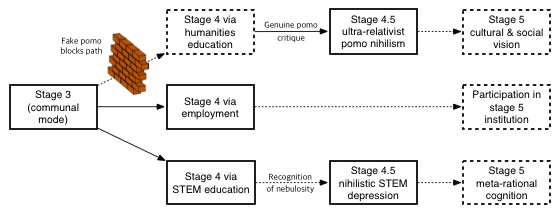
On the Necessity of Bridges Between Stages: the Nihilism of Stage 4.5
David Chapman:
"Ideally, a society and culture provides “bridges” of support from one stage to the next. To some extent, ours does. However, Kegan pointed out that we have allowed the bridge from stage 3 to 4 to fall into disrepair. We are not adequately teaching young adults how to be rational, systematic, or modern. This is the central theme of his In Over Our Heads: The Mental Demands of Modern Life.
This problem seems to have only gotten worse in the two decades since he wrote that. That is what makes me fear civilizational collapse. Keeping modern institutions operating requires cognitively modern, rational operators. We may be destroying the conditions necessary to produce them. I’ll explain this in more detail later.
Our society and culture do even less to support the transition from stage 4 to 5. This transition, between the rational and meta-rational stages, is particularly difficult; and no bridge has yet been built. This is an unrecognized lack—and so, an opportunity to contribute. It has, perhaps, never been seriously attempted, so it may be unexpectedly easy: “low-hanging fruit” that has not yet been plucked.
Between stages 4 and 5, there is a gap, a stretch of open ocean. One recognizes the limitations of rationality, but can’t yet work effectively in the meta-rational mode. Many people get stuck treading water here, trying to stay afloat, often not even able to see the dry land of meta-rationality on the horizon. With rationality seeming the only basis for meaning, they fall into nihilistic depression. This is sometimes informally called “stage 4.5,” although it is not a “stage” in the same sense as the others. It is not a workable mode of organization. However, its dysfunction is stabilized by spurious logic of nihilism. Some stuck there may be barely capable of everyday functioning. Others manage better, by recognizing the limits of rationality while continuing to use it effectively in practice.
The stages of individual development are manifest also in forms of social organization. Pre-rational psychology is typical of pre-modern societies—what I’ve described elsewhere as the “choiceless” or “communal” mode. Rationality is characteristic of systematic, modern societies. Postmodernity corresponds to the 4.5 breakdown."
(https://metarationality.com/stem-fluidity-bridge)
Postmodernism sabotages the bridge to rationality
David Chapman:
"In the 1970s and 1980s, the best postmodern/poststructural thinkers presented meta-rational views, based on their thorough understanding of systematic rationality.1 This first generation of postmodern teachers had a complete “classical education” in the humanities; they mastered the Western intellectual tradition before coming to understand its limitations.
Deconstructive postmodernism, their critique of stage 4 modernism/systematicity/rationality, is the basis of the contemporary university humanities curriculum. This is a disaster. The critique is largely correct; but, as Kegan observed, to teach it to young adults is harmful.2 Few university students have consolidated rationality. Essentially none are ready to move beyond it. Pointing out its defects makes their developmental task more difficult.
You cannot understand what is wrong with rationalism until you are capable of being rational. You cannot go beyond rationality until after you can use it reliably. You cannot become meta to systems you do not appreciate and do not understand how to deploy. You cannot move from stage 3 to stage 5 without passing through stage 4.
In fact, even most teachers of postmodern theory don’t understand it. Unfortunately, the postmodern pioneers chose to write in obfuscatory riddles. Their insights were difficult enough to understand without that. Few followers could extract the insights. Most teachers are second-generation professors who didn’t understand pomo when it was new, and third-generation ones who were mainly taught dumbed-down second-generation “pseudo-pomo.”
They were never taught to think, and can’t. What they learned was to imitate the founders’ appalling rhetorical style. They even learned to not think—because thinking would lead to questioning the nonsense, which would get you ejected from pomodom. Consequently, most contemporary pomo writing is—as everyone admits—incoherent blather, full of sound and fury, signifying nothing. That’s “pseudo-pomo.”
At this point, many humanities professors cannot take even a rational, stage 4 stance; they were not taught to think. Lacking that, they cannot critique rationalism accurately. They could not possibly transmit stage 5 meta-rationality to their students now.
“All systems must be destroyed”
Still worse, pseudo-pomo misunderstands the postmodern critique simply as “all systems are wicked, false ideologies invented by the powerful as means of oppression, and must be destroyed.”3
Unfortunately, “critical theory” has so far failed to produce a broad, positive, clear and practical meta-rational vision. With nothing beyond the discredited stage 4 to look forward to, it is mostly no longer possible for humanities majors to develop a rational, systematic self. Nor can they participate effectively in a rational, systematic culture and society. At best, if they do somehow make it to stage 4, deconstructive postmodernism can only push them on into the ultra-relativist nihilism of 4.5. In that abyss, you realize rationality is not the answer, but can see no alternative. There is essentially no support available for the further transition to stage 5.4
This scares me. Up until the 1980s, a university humanities department did teach you how to think—and it was the standard education for the ruling class. Since then, it has taught you not to think. What happens as people trained in postmodern anti-thought move increasingly into positions of power? Without an appreciation for administrative and technical rationality—much less the ability to deploy them personally—how can they lead governments, corporations, universities, churches, or NGOs?
Recently, major institutions seem increasingly willing to abandon systemic logic: rationality, rule of law, and procedural justice. Such systems lost credibility decades ago, and are under increasing cultural/political attack from the pomo-educated. But for now they are critical to maintaining civilization. Someone has to keep the machinery running. Until we can build a fluid, meta-rational stage 5 society, destroying stage 4 institutions means everyone will die. (Not to be alarmist or anything.)
Building a bridge to stage 5 may be critical to keeping the bridge to stage 4 open. Because the postmodern critique is correct, it’s intellectually indefensible to insist on rationality as The Way and The Truth and The Light. To make stage 4 palatable, it has to be clear that it is not the final destination. Confirming the accuracy of the critique opens the possibility of a third alternative to the stage 3 and 4 worldviews.
Saying:
“You are right, systems are not ultimately workable as the basis for society and culture” and “You are right, systems do always get appropriated by the powerful as means of oppression”
makes credible:
“Psychologically, understanding rational systems is a stage you need to go through to get beyond them” and “However imperfect, systems are the main way we currently know how to deliver the material and social prerequisites for life, so we need to keep them running for now.”
(https://metarationality.com/stem-fluidity-bridge)
The communal-to-systematic transition has become more difficult
Stage transitions cannot be accomplished solo. They require social support. When an individual is ready to move forward, the social environment should start to challenge their current developmental stage: to point out what doesn’t work in it, to disapprove dysfunctional behavior based on it, and to undermine its claims on meaning. During the transition, the social environment should provide support, in the form of a “safety net” that catches the person at times when they are unable to operate in the more advanced mode. As they gain competence, it should confirm (praise and reward) next-stage functioning.
In modernity, new adults often left home to take a position in a systematic institution, such as a job, university, or the military. Learning to deal with institutional demands drove one’s transition from the communal to the systematic mode. That was never easy, but the institutions provided some support. Also, importantly, the legitimacy of systematicity was mostly unquestioned. Society agreed that learning to function competently in systems was a good thing.
Postmodernism’s accurate critique of modernity has had dire consequences for the possibility of growing from stage 3 to 4. The very essence of the contemporary, postmodern liberal arts curriculum is the claim that all systems are merely arbitrary, self-interested justifications for power. That makes positive identification with systems impossible. It’s mostly only STEM majors who can make this transition—which is probably part of why we are taking over the world.
Institutions are also, increasingly, accommodating and even validating stage 3 behavior in young adults. (This is a point of current controversy in universities particularly.) Although done with the best of intentions, institutions’ failure to challenge the communal mode may be detrimental to both individuals and society in the longer run. I am concerned that our culture may increasingly be actively impeding personal growth into systematicity—and providing less of the necessary support for it. More people are getting stuck in an earlier developmental stage. This may become disastrous.
(I suspect the recent upsurge in monist spirituality may be one manifestation of this problem.)
Some conservatives recognize this problem, and want to push back against postmodernism’s nihilism. That’s the right impulse, but postmodernism is actually right about the defects of systematicity (modernity). Failing to acknowledge the validity of that critique makes such conservatism intellectually indefensible.
Both individuals and societies should recognize that systematicity is not wrong, it’s just limited. It’s a valuable and necessary stage of development. It’s impossible to reach stage 5 without going through stage 4. You cannot become meta to systems without having systems to be meta to.
It would be helpful if it were widely understood that systematicity is not the final goal. Understanding that fluidity is not dualist should be particularly important for people who are allergic to dualism.”
(https://vividness.live/developing-ethical-social-and-cognitive-competence#stages)